
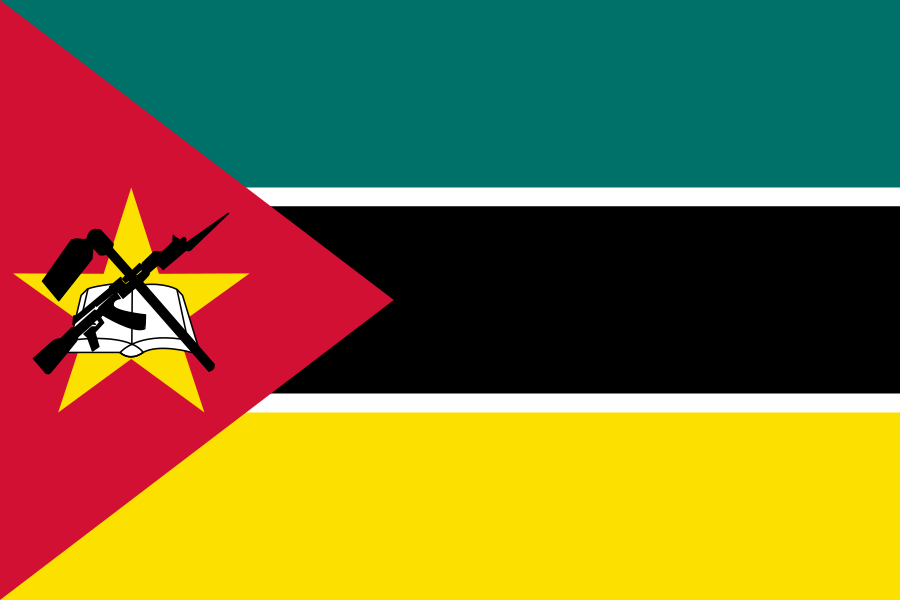
Governance & legal system
Mozambique is a founding member of the Southern African Development Coordination Conference (SADCC) which was formed in Lusaka, Zambia, in 1980, and later transformed into the Southern African Development Community (SADC) in 1992.
Mozambique is a member state of the African Union since 1975 and has ratified the OUA Convention on Refugees in Africa in 1988.
Mozambique is a semi-monist country, meaning that international law does nor always need to be translated into national law to be applicable. Depending on the legal nature of the act of ratification of an international treaty and its subsequent publication, the treaty could be directly incorporated into national law. According to the provisions of the Constitution, by ratifying a treaty and publishing it the Government Gazette (Boletim da República), Mozambique assumes a legal obligation to implement the rights recognized in the treaty and – as states by the Vienna Convention on the Law of Treaties, to which Mozambique is a signatory – it must comply with the obligations of the treaty in good faith.
Article 18(1) of the Constitution sets out that “[t]reaties and international agreements, validly approved and ratified, are enforceable in the legal system of Mozambique immediately after their publication and as long as they are internationally binding to Mozambique”. Additionally, Article 18(2) of the Constitution establishes that “[t]he norms of international law shall have the same force in the Mozambican legal order as have infra-constitutional legislative acts of the Assembly of the Republic and the Government, according to the respective manner in which they are received” – meaning that the act adopted to ratify a convention or a treaty will define the legal nature of the provisions contained in the treaty itself.
Mozambique operates under a unitary system of government, as described in article 8 of the Constitution of Mozambique. All political power and authority are concentrated at the national level, and the central government has the sole authority to make and enforce laws throughout the country. Local governments and administrative divisions exist, but they derive their powers and functions from the central government and can be modified or dissolved by it.
The Constitution outlines the three branches of government and their functions:
- Executive Branch: The President of Mozambique is both the head of state and the head of government. The President is elected through universal, direct, equal and periodic suffrage, and by personal and secret ballot. The President is responsible for running the government, implementing policies, and overseeing the administration. The President is also the Commander-in-Chief of the Armed Forces of Mozambique (Article 145-162 of the Constitution of Mozambique).
- Legislative Branch: The Parliament of Mozambique, known as the Assembly of the Republic, is the country's legislative body. It is a unicameral parliament, meaning it has only one chamber. Members of the Assembly are elected through direct, universal, equal, secret, personal and periodic suffrage, and they are responsible for making and passing laws (Article 167- of the Constitution of Mozambique).
- Judicial Branch: The judiciary in Mozambique is independent of the executive and legislative branches. It interprets and applies the law, ensuring that it is in accordance with the constitution and legal principles. The highest court in Mozambique is the Supreme Court, which serves as the court of last resort (Article 211-232 of the Constitution of Mozambique.
Mozambique's legal system is primarily derived from Civil Law, which is influenced by the German Romanic legal tradition. The legal framework relies on written legislation. The constitutional norms shall prevail over all the other norms of the legal order (article 2 of the Constitution of Mozambique). Key legal codes, including the Civil Code, the Penal Code, the Civil Proceedings Code, the Penal Proceedings Code, the Commercial Code, among others, form the foundation of the legal system.
The Constitution of Mozambique, dedicates a section to the court structure, reaffirming the independence and sovereignty of the courts in administering justice on behalf of the people.
Article 211: 1. It shall be the function of the courts to guarantee and strengthen the legality as an instrument of legal stability, to guarantee the respect for the laws, safeguard the rights and freedoms of citizens, as well as the legal interests of other bodies and entities that have legal existence. 2. The courts shall punish violations of the legal order and shall judge the cases in accordance with the law. 3. The law may establish institutional and procedural mechanisms for coordination between courts and other authorities dealing with the settlement of interests and the resolution of disputes.
Article 222 of the Constitution of Mozambique: 1. In the Republic of Mozambique, there shall be the following courts: a) the Supreme Court; b) the Administrative Court; c) the judicial courts, 2. There may be administrative courts, labour courts, fiscal courts, customs courts, maritime courts, arbitration courts and community courts. 3. The powers, organisation and functioning of the courts referred to in the preceding paragraph shall be established by law, which may provide for an intermediary court between provincial courts and the Supreme Court. 4. The judicial courts shall have common jurisdiction in civil and criminal matters and shall exercise their jurisdiction over all areas not assigned to other jurisdictional orders. 5. At first instance, there may be courts of special jurisdiction and specialised courts to judge particular matters. 6. Without prejudice to provisions pertaining to military courts, the establishment of courts with exclusive jurisdiction to judge specific categories of crimes shall not be permitted.
- Supreme Court: The highest court in the country, located in Maputo, with national jurisdiction. Composed of professional and elected judges, it acts as both a 1st level court in certain criminal cases and a 2nd level court for appeals.
- Superior Courts of Appeal: Function as courts of second instance and first instance. They hear appeals and conflicts of jurisdiction among other courts within their area.
- Provincial Judicial Courts: Found in each province, except Maputo with two, they decide 1st level cases and serve as a second-tier for district courts. Appeals from these courts go directly to the Courts of Appeal.
- District Judicial Courts: Intended for each district, responsible for 1st level cases, but not yet fully implemented.
- Labour Courts: Established in 2018, they handle labour-related conflicts and contraventions of labour and social security norms.
- Administrative Court: Established in 1992, supervises the constitutionality and legality of administrative decisions, contracts, and regulations.
- Customs Court: Established in 2001, deals with customs matters.
- Fiscal Court: Established in 2004, handles tax-related disputes.
- National Institute for Refugees – INAR - : created under Decree no. 51/2003 of 24 December. INAR is supervised by the Ministry of Home Affairs and oversees the area of assistance to refugees and asylum seekers. INAR is a national institute with a jurisdiction that extend all over the country. It has offices in Maputo, Nampula, Tete and Cabo Delgado. INAR´s has the following legal attributions and competences: (a) Support and assistance to refugees and asylum seekers in Mozambique, (b) Coordination with national and foreign entities tending to guarantee the security and stability of refugees and asylum seekers (c) Organize asylum application processes, with regard to the acquisition of identification and travel documents, (d) Update the individual files of refugees and asylum seekers, (e) Promote access to education and health by refugees and asylum seekers, (f) Promote projects aiming to the self-sufficiency of refugees, (g) Coordination and articulation with the Consultative Commission for Refugees, (h) Creation and daily management of accommodation centres regarding distribution of food, goods for individual use and other necessary services.
- Ministry of Home Affairs: is the entity that decides on asylum requests. After INAR has compiled and organized the files, the asylum petitions are sent to the Ministry of Home Affairs for a decision. The Ministry of Home Affairs is also the entity that decides on expulsion of refugees.
- National Migration Service: is the entity responsible to issue residence permits to refugees and asylum seekers, as well as to issue travel documents to refugees.